The Apprentice Model
Leadership multiplication involves training others to lead well.
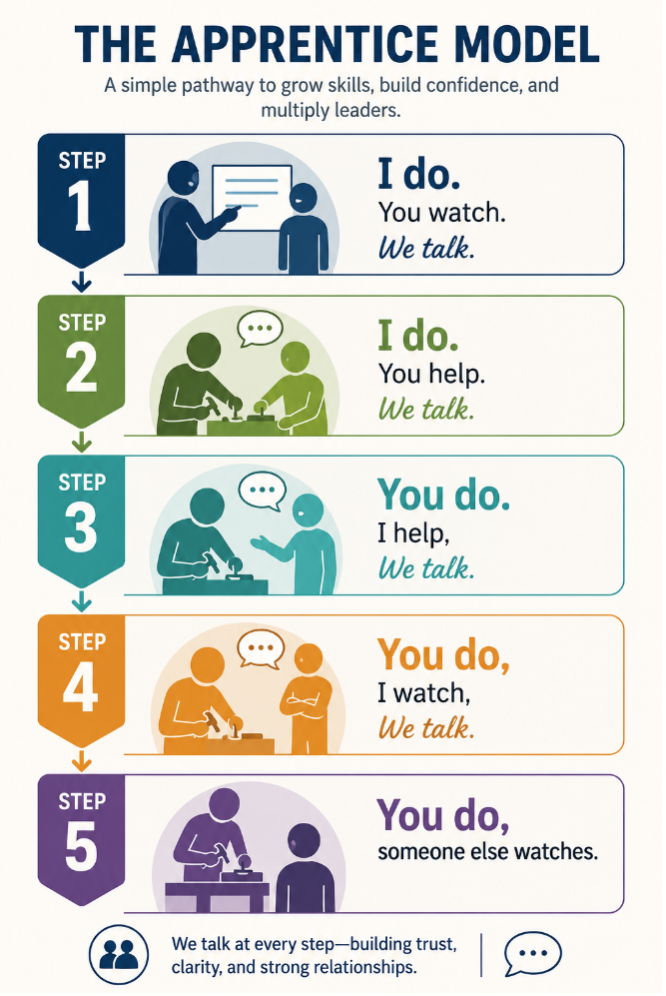
This model allows others to observe, participate, and eventually lead ministry activities, in order to develop and encourage leaders in the church.
The Apprentice Model provides a structured process for bringing out the leadership ability in others. It requires a leader who mentors a learner as an apprentice. Are you a leader in your church? Invite someone to help you as an apprentice. Would you like to help a leader in your church? Ask your pastor to be an apprentice to a ministry leader. This model works well for preparing small group leaders, mission trip leaders, outreach leaders, and all types of ministry group leaders.
The apprentice’s progression from watching to doing to mentoring another person flows logically. The “we talk” phase benefits both mentor and apprentice by having a purposeful, intentional conversation about the experience.
During the “we talk” phase of the apprentice model, the mentor and the apprentice engage in a structured conversation to bridge the gap between observation and execution. These structured debriefs reflect on three main questions:
- What worked? Identify the strategies, techniques, and decisions that the mentor used effectively during the session. Be sure to discuss the unwritten guidelines, intuition, active listening moments, and decisions the mentor relies upon that are not easily written down.
- What could have worked better? Discuss possible pitfalls and how to react when something does not go as planned. Review any errors and/or missed opportunities to engage the audience.
- How can we improve? Outline exactly what parts of the task the apprentice will be responsible for executing in the next session. Brainstorm practical adjustments to try next time, with the apprentice’s help.
Breaking this down for ministry and discipleship:
In a ministry context, the “we talk” phase includes technical skills development as well as nurturing spiritual discernment, relational chemistry, and leadership confidence. When debriefing a ministry like a mission trip, an outreach like a food pantry or a vacation bible school, or a small group meeting, emphasize the importance of evaluating heart posture, relational connections, and communication mechanics.
Listening and Heart Posture
Ask the apprentice to evaluate how well they truly heard the people that are being served. For example, did a guest at a food pantry mention a sick relative? Did a small group member’s tone change when answering a specific question? Did a mission team participant show fear on their face while a ministry activity or cultural practice was described? How was a basic response turned into a deeper spiritual or personal moment?
Review how the mentor responded to these ministry opportunities and discuss strategies the apprentice can use to build the habit of listening with their heart for opportunities to minister. This may include discerning “on-ramps” that invite spiritual or personal conversations. Practice asking open-ended questions during the debrief to build muscle memory for next time.
Auditing Audience Engagement
Whether discipling one-on-one or managing a group of children in a VBS setting, it is important to assess the level of audience engagement and make adjustments to deepen engagement when necessary or appropriate.
During the “we talk” phase of apprenticeship, review how voice inflection, body language, and strategic silences are used to assess audience engagement and regain focus gently.
Discuss how to gently balance the talkative sharer with drawing out the quiet participant. Also, talk about how to use eye contact to draw out responses and communicate caring interest.
Set Up the Next Learning Opportunity
Before ending the debrief conversation, be sure to agree upon the apprentice’s next steps. Outline exactly what manageable pieces of the ministry they will lead next time.
This may be something simple like asking an open-ended question to start the session and saying the closing prayer. If the apprentice has demonstrated aptitude, then asking them to manage a key conversation or training module would be an appropriate next step.
Looking for next steps?
Talk with your pastor about being a mentor or apprentice and see how you can increase your impact in and for the church.