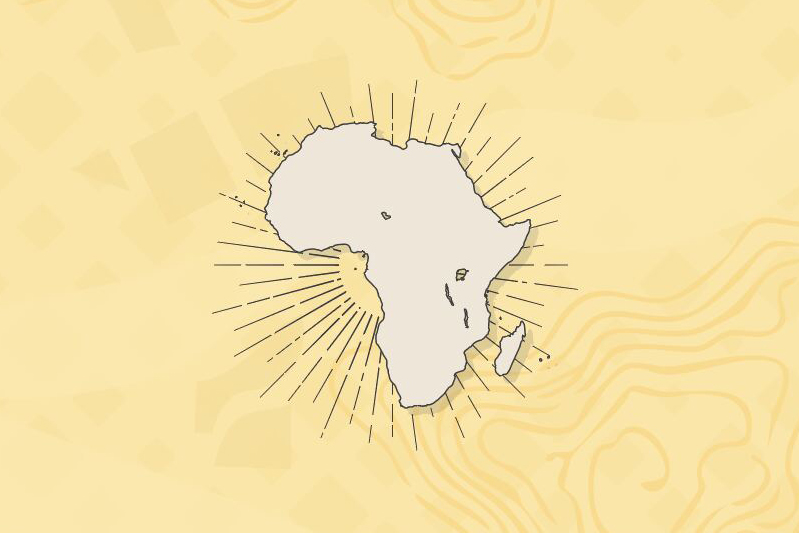



God is a global God—and it’s also clear that he has had a heart for Africa from the beginning of redemptive history.
The earliest sojournings of the patriarchs found them in Egypt, witnessing to the one true God in a pagan land (Genesis 12:10). Later, those same people saw the glory of God through the exodus (Exodus 14). The prophet Isaiah testified, saying “Egypt my people” (Isaiah 19:25). God used the Ethiopian Ebed-melech to deliver the prophet Jeremiah (Jeremiah 38:7–13). In the Book of Acts, the African church was born through another Ethiopian eunuch providentially placed in the path of Philip the evangelist (Acts 8:26–40).
God’s purpose in history is to saturate the earth with the knowledge of his glory through the saving reign of Christ (Isaiah 11:9, Habakkuk 2:14). Yet for centuries the Christianized world has regarded Africa as “the dark continent.”
If the church is to fulfill Christ’s purposes in the Great Commission in Africa—making disciples of the African nations, baptizing them, and teaching them to obey all that he commanded (Matthew 28:19–20)—then four biblical approaches will prove vital.
1. Partner with the whole indigenous church.
The Great Commission that Jesus issued his disciples was the apostles’ bequest to the whole church. The whole people of God is needed to fulfill the whole mission given by God. Only as the body of Christ works together, using every gift and building each other up in love (Ephesians 4:11–16), can the full expression of Christ’s kingdom be seen among the peoples of Africa. In Togo, that means church planters laboring alongside Togolese pastors. In South Africa, it looks like multiethnic congregations planted in Cape Town, Durban, and George. In North Africa, it calls for workers serving beside bold local believers in creative-access contexts.
2. Equip African leaders to reach Africans.
Paul instructed Timothy to take what had been entrusted to him and entrust it to godly men who, in turn, would entrust it to others (2 Timothy 2:2)—resulting in four generations equipped for pastoral ministry. Missionaries reaching Africa must not see themselves as lone gunslingers apart from the whole intergenerational story of how Christ’s kingdom is built. In Togo, this looks like training African pastors to lead indigenous local churches: more than 80 percent of ABWE churches planted in Togo are now led by local pastors. It also looks like partnering ABWE’s two hospitals in Togo with the Pan-African Academy of Christian Surgeons to equip African medical missionaries to reach contexts where North Americans cannot easily go.
3. Build durable Christian cultures.
We Americans tend to conceive of Africa as a single monolithic continent, when in fact it is a massive and diverse array of cultures, languages, and religions. Africa contains some of the world’s most hostile Islamic and animistic peoples and some of its most fervent Christian communities—the fruit of missionary labors seeking to obey the cultural mandate (Genesis 1:28). In 1996, Zambia enshrined itself in its constitution as a Christian nation. Missionaries should cheer on the African church and lean in as its gospel influence reaches farther. Our allergy to nominalism should not stop us from seeing that a foundation for biblical Christianity already exists. Durable Christian cultures living out the implications of Christian faith in laws and customs, albeit imperfectly, can become the seedbed from which more faithful evangelists are sent.
4. Proclaim a pure, unadulterated gospel.
While Christianity has exploded across large swaths of Africa, one consequence is a version of Christianity that has a form of spirituality but lacks the real saving power of the gospel. Hyper-charismaticism and word-of-faith prosperity theology represent a syncretism between notions of material blessing from traditional African religions and a thin veneer of Christianity. Powerful men seize on the gullibility of the weak and build personal platforms of wealth and prestige. The only thing that can combat the proliferation of false gospels is the unashamed proclamation of the truth. The biblical gospel offers eternal life through faith in Christ—a faith more often marked by suffering and self-denial than ease and comfort (2 Timothy 3:12). The gospel is the power of God unto salvation (Romans 1:16). Let us be tireless in seeing it spread to the ends of the earth, including to the peoples of the African continent.