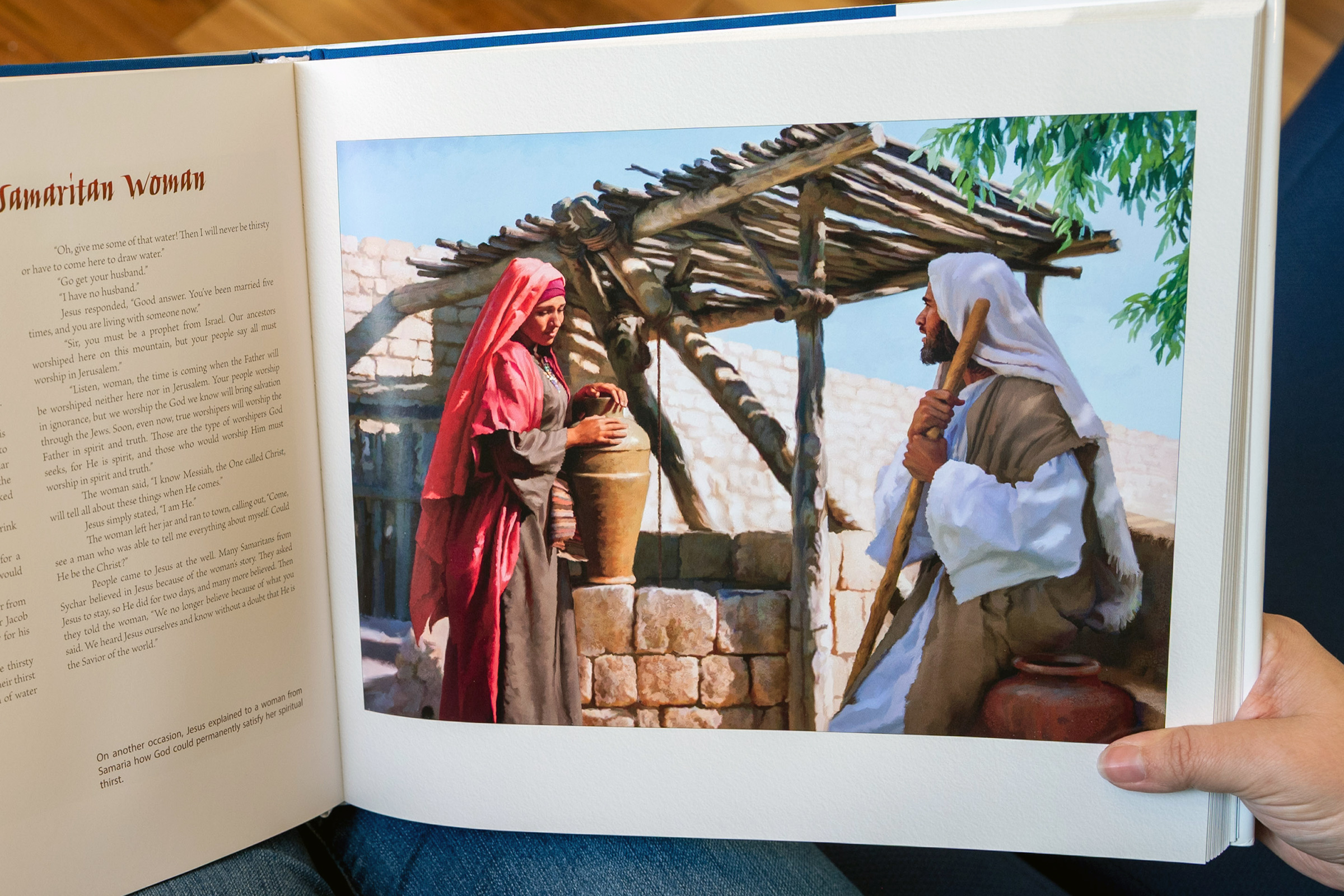



Editor’s Note: For another perspective on using images of Christ, see “Don’t Leave the Second Commandment at the Door” by Landon J.
Ignatius of Antioch, writing in the second century, exhorted, “Wait expectantly for the one who is above time: the Eternal, the invisible, who for our sake became visible; the intangible, the unsuffering, who for our sake suffered, who for our sake endured in every way” (Letter to Polycarp, 3.2).
Consistent with this beautiful passage is the Chalcedonian definition that confesses Christian Christology, “We . . . acknowledge one and the same Son, our Lord Jesus Christ, at once complete in Godhead and complete in manhood.” The truth that this one Christ is both truly God and truly man, both undepictable and depictable, is a wonder of Christian theology.
From Forbidden Formlessness to Incarnate Image
The reality of the incarnation dramatically changes the situation of the Israelites, who were told not to make carved images of God for themselves, for when he spoke to them, they “heard the sound of words, but saw no form; there was only a voice” (Deuteronomy 4:12). An image would have been impossible “since you saw no form on the day that the Lord spoke to you” (Deuteronomy 4:15). Yet, with the incarnation came a shift, which the apostle John captures well: “That which was from the beginning, which we have heard, which we have seen with our eyes, which we looked upon and have touched with our hands, concerning the word of life” (1 John 1:1).
Indeed, Christ is the “image of God” (2 Corinthians 4:4), the invisible God made visible (Colossians 1:15). When God fashioned a human nature to assume in the incarnation, he created an image: the divine Son enfleshed. How can this impact our question of whether images of Christ are permissible?
When God fashioned a human nature to assume in the incarnation, he created an image: the divine Son enfleshed.
The Second Commandment
It is important to point out that I advocate for a limited (or restricted) making and use of images of Christ. That limitation excludes liturgical images or images used for worship, while allowing for images in education, missions, and art. Amid century-long debates on the subject, I align with those who, following the Protestant Reformation, held that the extent of the second commandment is to expressly forbid images when used as objects of worship.[1]
The second commandment (as divided in Exodus 20 by many interpreters) reads as follows:
You shall not make for yourself a carved image, or any likeness of anything that is in heaven above, or that is in the earth beneath, or that is in the water under the earth. You shall not bow down to them or serve them, for I the LORD your God am a jealous God, visiting the iniquity of the fathers on the children to the third and the fourth generation of those who hate me, but showing steadfast love to thousands of those who love me and keep my commandments. (Exodus 20:4-6 ESV)
There are two observations worth noting. First, if we organize the commandments according to the understanding of Jewish, Lutheran, and other traditions, the context and concern of the prohibition against making images (rendered as “idols” in the LSB) becomes quite apparent. These traditions see “You shall have no other gods” as part of, rather than separate from, the commandment, “you shall make no idols.”[2] This illuminates the context of the command in light of the central role that images held in pagan worship as mediators of divine essences—essentially functioning as the gods themselves for those who fashioned them.[3] For those in the Ancient Near East, “making an idol” was literal, rather than figurative. Second, the commandment prohibits making idols to “bow down to or serve them.” The commandment does not even detail that images can’t be placed in places of worship—and if it did restrict this, the text would create a contradiction from God (as discussed in the following section). Both of these points are crucial: idols were not mere images but vessels for deities and objects of worship, and the commandment pertains to the worship of these images as false gods.
The concern is about worship and idols, and in the context of Israel, no image could be made of God “since you saw no form on the day that the Lord spoke to you” (Deuteronomy 4:15). The often-cited incident with the golden calf highlights this principle in that the people attempted to depict the invisible God, and they worshiped God through that image as if it were God (or his housing).
God Approved Images in the Old Testament
If the second commandment was and is indeed a wholesale rejection of images of “things in heaven and earth” (i.e., every created thing), then we would be in violation up to our ears. Furthermore, we would face a conundrum regarding God’s own institution of images, crafted by the Israelites, in the holiest places used for worship. For example, images of cherubim (things in heaven) were placed in the tabernacle and temple (1 Kings 6:23-29) alongside water chariots (7:28). Pomegranate trees (things on earth) decorated the walls of the tabernacle and temple (6:29), while objects inside included 12 oxen (7:23-25), bowls carved to resemble almond blossoms (Exodus 25:33-4), and carved lily blossoms on pillars at the entrance of the temple (1 Kings 7:22). In the wilderness, God commanded the Israelites to make the bronze serpent (Numbers 21:8-9), which, understood in that immediate context and by John, was a symbol of God’s salvation. In the case of the bronze serpent, King Hezekiah only called for its destruction when the image was worshiped (2 Kings 18:4).
It is important to highlight that these images aren’t trivial. Oxen (related to the golden calf misused by Aaron) were used as symbols in pagan religious contexts, and, as we know from various scriptural texts, angels were often worshiped. Yet, rather than considering them a slippery slope, their image was found in places of worship.
Idolatry vs. Imagery
Thus, we must clearly delineate the issue: idols are idols because they are images being worshiped as gods; they are not mere imagery or artwork. Although some collapse this distinction by suggesting that worship can occur unintentionally (“you cannot help but worship an image”), this runs contrary to the standard understanding of worship as a volitional act of ascribing glory and honor to God.[4] Arguments against images of Christ often rely on conflating this reality.
Depicting the Depictable
Beyond this, we are often told that man cannot make any image of God (or that represents God) from anything in creation; the second commandment extends to images of God in all forms. The rationale for this view is that nothing can fully represent God’s glory.
In Scripture, the Father is the only person of the Trinity not depicted. Yet, the Son has a human nature; he is made visible. Not only this, but he is depicted as a lamb (John 1:29), a lion (Revelation 5:5), the morning star (22:16), the sun (Malachi 4:2), the rock (1 Corinthians 10:4), the bread (John 6:35), the door (John 10:9), and the vine (John 15:1), along with other images. Did the New Testament authors violate the second commandment by eliciting imagery in the minds of those who heard or read the Gospels? (Images pictured within a person’s mind are considered violations of the second commandment, according to some interpretations, such as the Westminster Confession of Faith.[5]) And what of the Spirit who has no physical form? The Spirit is depicted as a dove (Matthew 3:6; Luke 3:22), fire (Acts 2:3), oil (1 John 2:20-27), water (John 7:38-39; Isaiah 44:3), and even a seal (Ephesians1:13-14). Some would go so far as to say that making visual images of these is indeed a violation,[6] which would be consistent with that view, yet unfortunate, as these are biblically prescribed “images.”
These God-breathed images are not only “made” but are also artistic and used in Scripture for pedagogical purposes. They aid students of the New Testament—whether those in the immediate context of the ancient world or in modern times—in grasping the things of God. Do these images, individually, display the complete picture of God’s glory? No, of course not. Nobody, except the divine persons themselves, has seen the full extent of God’s glory, nor does even Scripture show us the full splendor of the glory of God. The argument that depictions of God in these ways are inappropriate because the full glory of God cannot be seen is akin to saying that you ought not to preach about God because you could never describe his full glory. Including the fullness of God’s glory in images is a demand never made in Scripture (cf. Ezekiel 1:28; John 1:14; 2:11). The issue is not whether an image captures everything, but whether it truthfully reflects what Scripture affirms, and that the image is not being worshiped.
Faithful Representation, Not Exact Replication
What of the incarnation itself? In the humility of the divine Son, his glory was veiled (Philippians 2:5-11), yet his humanity did not minimize his glory. Even so, his visible humanity did not reveal the full glory of God, nor was his divine nature seen, as it is invisible! The divine person, enfleshed, however, was visible. He looked like any other man of his time, as the second Adam, an “image” created by the Father for the incarnate God we may see. When reading about Jesus’ life, we don’t imagine a spirit as if we are docetists, but a true man. Depictions are “false witnesses” only if we naively expect art or historical reconstructions to be 100 percent accurate to what Jesus looked like, or if the event in its depiction is false.[7]
Scripture does not give us fine facial details; it gives us a faithful pattern of truth about Jesus’ visible humanity—he was a man among men, not one glowing with divine splendor or heavenly light in his earthly ministry (Philippians 2:7-8). Therefore, depictions of Christ do not need to be exact to be truthful; they must be faithful to the biblical witness. The divine nature could never be depicted (as it is invisible), but events that demonstrate his divine nature most certainly can. Faithfulness is not found in facial precision but in theological representation. We can therefore ask of an image: Is this faithful to Jesus, who taught, suffered, died, and rose again as the Scriptures declare?[8]
Faithfulness is not found in facial precision but in theological representation. We can therefore ask of an image: Is this faithful to Jesus, who taught, suffered, died, and rose again as the Scriptures declare?
History and Missions
Outside of the liturgical debates of the eighth century regarding veneration,[9] images of Jesus can be found dating from early in church history (especially those depicting him as “the Good Shepherd”). Images were natural to those who couldn’t read the narrative of Christ; they had to imagine it as they heard it. Images were used to demonstrate and communicate the glory of God’s plan of redemption.
Concerning the use of images in education and evangelism, as long as the tools being used are faithful to Scripture, they can be, and have been, beneficial. For children, seeing a depiction of Jesus Christ as a real person solidifies in their minds his place in history—and rightly so, as they often see other depictions of biblical figures who are not as great as our Lord and Savior. They need not try to imagine a bodiless spirit teaching the disciples but can learn from an artistic depiction of the wonder of God enfleshed, truly man.
In missions, visual media can be a powerful tool, using images dawned in art to move people to marvel at the truths of Scripture, especially in cultures in which people are predominantly oral or animistic. According to Mission Network News, the Jesus Film has proved just that, reporting notable testimonies from around the world, including the conversion of idol worshipers.[10] Even in America, where reading is declining,[11] media can prove helpful in sharing the gospel.
Conclusion
This is a big topic with further considerations, including abuses, but these concepts provide one piece in the larger discussion. Are images of Christ forbidden? I don’t believe so, as long as they are not worshiped as if they were Christ himself. Images can help us grow in our understanding of Jesus, who lived among us and looked like us, the invisible made visible, Immanuel.
[1] For example, the original Geneva Bible, Zurich Bible, and King James Bible all have images on the title pages.
[2] See Wellum and Gentry’s summary of the issue in Kingdom Through Covenant, p. 365-367
[3] See Walton, “Interpreting the Bible,” p. 309-13, and Block, “For the Glory of God,” p. 31-35.
[4] It is in this area, especially, that worship is often confused with cognitive or emotional responses. Admiring art or being emotionally stirred by a story of Christ’s mercy is not automatically an act of worship. Worship, in the case of images, would involve ascribing divine honor to the image, treating it as a stand-in for God. This distinction is widely recognized in other areas of Reformed theology, in standard definitions of worship, and in critiques of altar calls, where emotional experiences are not equated with genuine worship or saving faith.
[5] Some consider mental images as irrelevant, yet in first-century cultures in which people relied on oral narratives, it would be important. Additionally, it has been well established in the field of science that most readers perceive mental images during reading. Further note that the Westminster Confession of Faith also prohibits “any image whatsoever.”
[6] Many adhering to this view also include things such as the scene with Moses, YHWH, and the burning bush.
[7] Some argue that depictions of Christ violate the ninth commandment by bearing false witness about his appearance. But this misunderstands the nature of both the commandment and the depiction. The ninth commandment is concerned with malicious or harmful falsehoods, especially in legal or covenantal contexts, not with every instance of artistic approximation. A painting or image does not claim precise historical or photographic accuracy; it aims to portray theological truth, not make an empirical claim about Jesus’ exact facial structure. It is no more a lie than a sermon illustration or dramatization.
[8] For more on art, including on Jesus depicted as different ethnicities, see PCA writer Jeffrey Meyer’s “When We Need Pictures of Jesus: A Study of Art, Worship, & the Second Commandment.”
[9] For a relevant classic, read “Three Treatises on the Divine Images” by John of Damascus.
[10] https://www.mnnonline.org/news/jesus-film-ministry-continues-to-grow/#:~:text=This%20man%27s%20transformation%20greatly%20affected,Blind%20Bartimaeus.
[11] https://news.gallup.com/poll/388541/americans-reading-fewer-books-past.aspx.
Editor’s Note: This article reflects the views of the author and is not intended to indicate a position of ABWE.