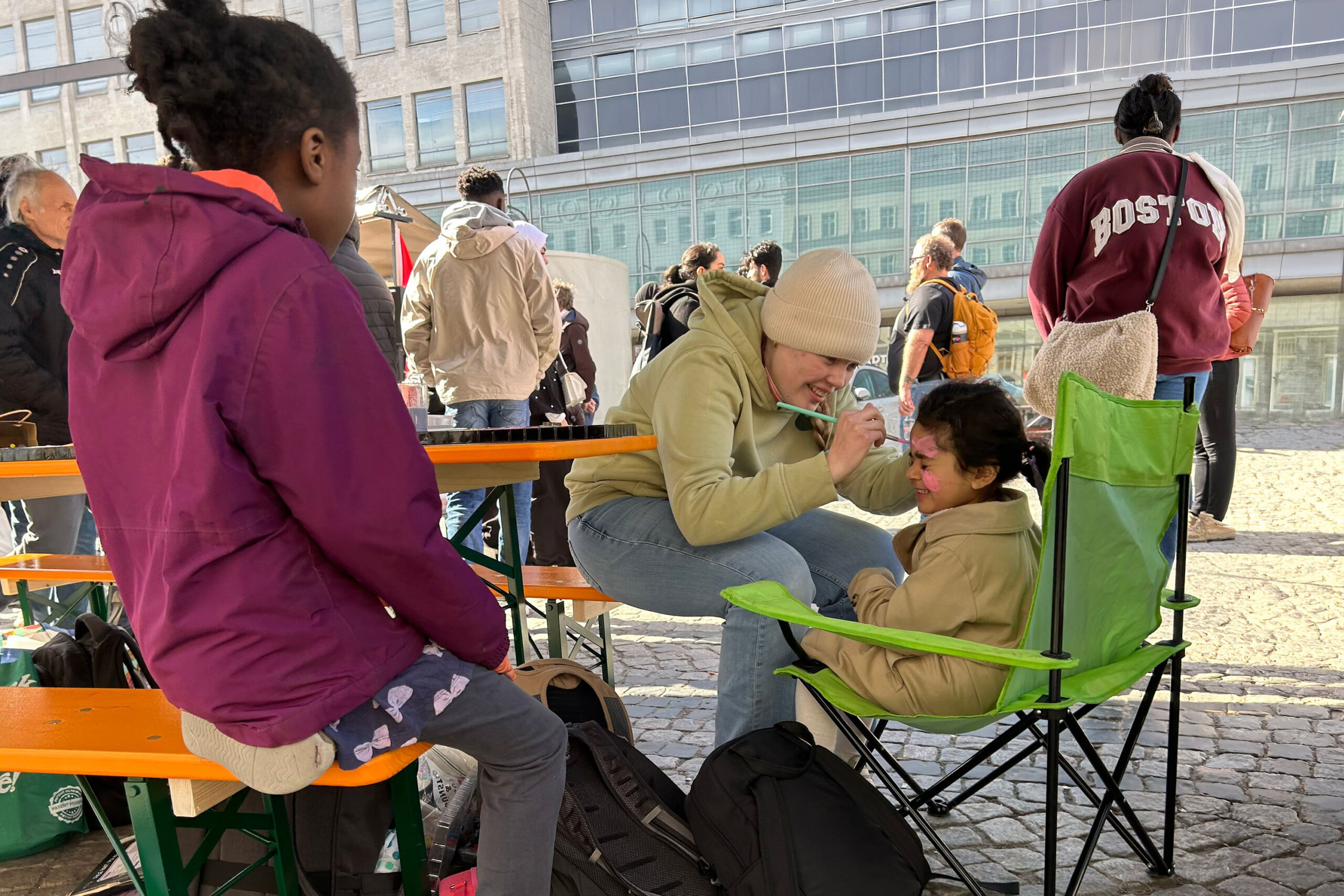


The bright flowers our daughter painted on a little girl’s face, and the butterfly on her sister’s, sharply contrasted with the horrific scenes their mother described to my wife, Beth, from the war they had fled in Syria.
We met the family during our church’s Easter outreach in Hermannplatz, a busy square surrounded by one of Berlin’s largest Arabic-speaking communities. Mohamed, his wife, and their two daughters were visiting from Austria. While the girls enjoyed the activities, Beth spoke with their mother in Arabic. The young woman, still in her 20s, described the violence and killings that had come terrifyingly close to her home. She had escaped the war but still carried its trauma. In fleeing Syria, she had left behind not only the danger but also the life and dreams she once held.
Meanwhile, Mohamed and I talked about Easter. He seemed curious about Christianity, though his questions reflected Islamic teachings. Muslims believe Jesus is in heaven, he reasoned, and Christians believe Jesus is in heaven. Were our religions not essentially saying the same thing?
His question revealed how similar words can conceal profoundly different beliefs. I began explaining that the Christian message is that the Son of God died on the cross for our sins, was buried, and rose bodily from the grave. Islam denies this essential truth. Without Christ’s atoning death, there is no satisfaction of divine justice; without his resurrection, our faith is futile and we remain in our sins.
Before we could go much further, the commotion of the square interrupted us. I was painfully aware that these truths require more than a hurried conversation. Mohamed needed time with believers willing to listen, boldly proclaim truth, humbly answer questions, and patiently open God’s Word with him.
Before he left, I gave him a gospel booklet and a beautiful Arabic edition of the Sermon on the Mount. He received them gratefully. As the family walked away, he carried the words of the Jesus he thought he already understood.
Their visit reminded us that unreached Muslim immigrants live not only in Berlin but are scattered throughout Europe, often in places with few churches prepared to reach them.
We are thankful that God has brought people from restricted-access nations into cities where we can freely place Scripture in their hands. Yet we also mourn Europe’s abandonment of its Christian heritage that limits its own people’s opportunities to encounter the gospel. Biblical worship has increasingly been displaced by secularism, revived paganism, and Islam. Europe may offer refugees physical safety, but its pluralistic culture cannot offer pardon for sin, hope of eternal life, or reconciliation with God.
In Europe, God has brought the nations to our doorstep. May we seize this moment to place his Word in the hands of Europeans and immigrants alike and proclaim the life-giving hope of Christ to their hearts.