


Not long ago, I sat across the table from a man who has spent more than a decade working in the Middle East.
At one point in the conversation, he said something I had to ask him to repeat.
“You could serve as a pastor in Iraq today. Openly.”
I confess my mental map had no category for that sentence. Iraq sits near the top of nearly every list of difficult places for Christians. Surely a missionary there needs a business platform, a cover story, a creative-access strategy. Surely the word for Iraq is closed.
But my friend was right, and my map was wrong. And the more I have thought about that conversation, the more convinced I have become that many of our mental maps, the categories we assume regarding “open” and “closed” countries, may be silently distorting how our generation thinks about pioneering missions.
Before we ever talk strategy or devise a plan to go to the unreached, it’s important we correct our assumptions. Consider four ways our assumptions may need to be challenged with respect to closed and difficult mission fields.
1. We treat “closed” as one category.
When we call a country closed, we usually mean one undifferentiated thing: hard to reach, hostile, dangerous, keep your head down.
But closure takes two distinct forms. A country can be closed legally: the law forbids missionary activity, religious visas do not exist, and evangelism is criminalized. Or a country can be closed culturally: conversion carries a social cost, families and communities resist the gospel, and persecution comes from neighbors rather than statutes.
Those two axes form four quadrants, and they do not overlap as neatly as we tend to assume. Some countries are legally closed but culturally receptive. Others—and this is the quadrant we chronically overlook—are culturally closed but legally open.
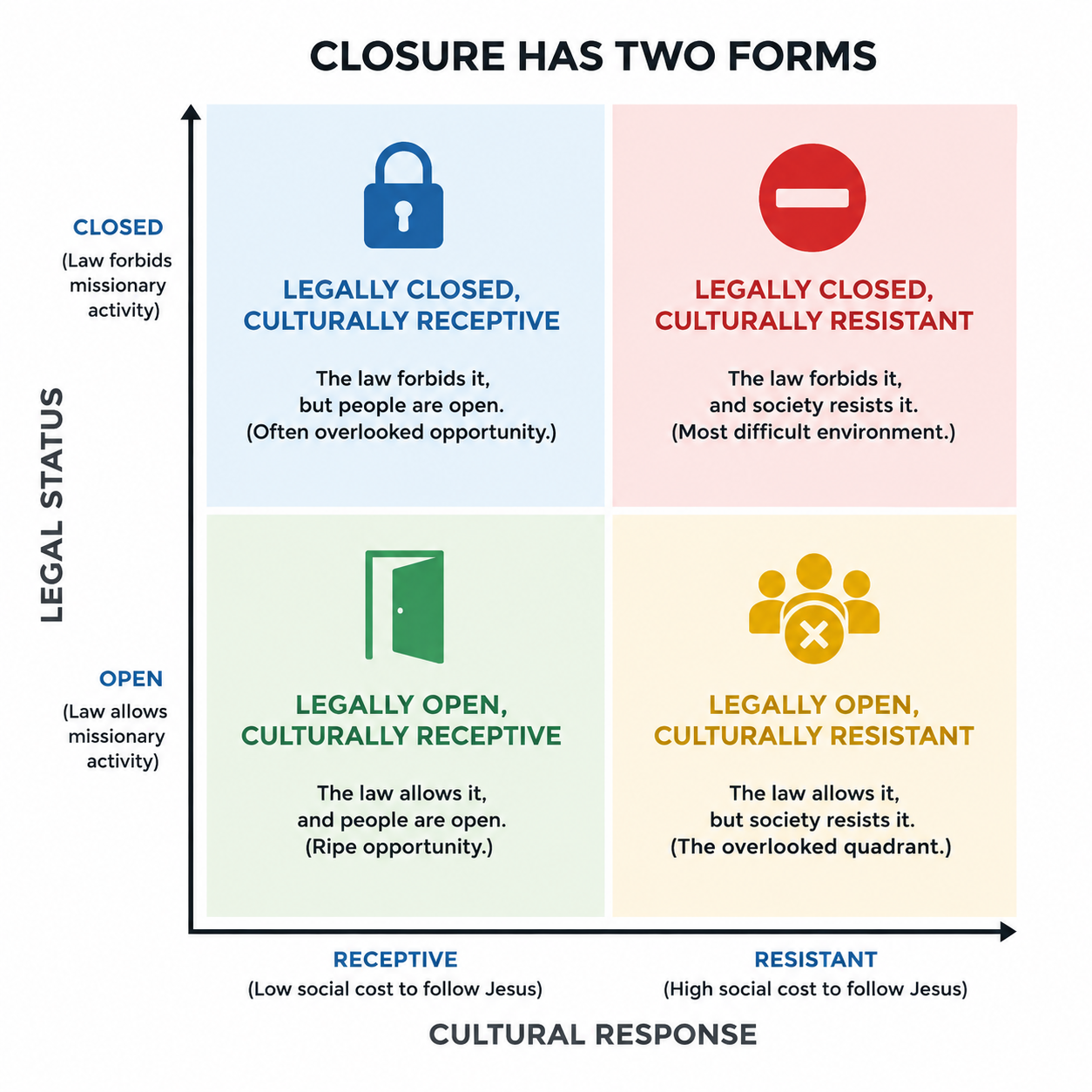
Iraq is a case in point. No statute explicitly criminalizes the sharing of one’s faith. The constitution guarantees freedom of religious belief and practice, and legally recognized evangelical church bodies operate openly, especially in the Kurdistan Region. However, cultural and family pressure against conversion is severe, and real legal ambiguities remain. But a worker there does not need a cover story. He can enter as what he is: a religious worker serving with churches the government itself recognizes.
When we flatten the four quadrants into a binary, we end up treating a country like we would the hardest police state on earth, sneaking about where we could simply walk openly.
2. We let the platform drive the church.
The standard playbook for restricted contexts begins with a platform: a business, a school, a clinic, or an NGO. The platform secures the visa, and then, in the margins of an exhausting full-time job, the missionary tries to squeeze in the actual work of evangelism, discipleship, and church planting.
Anyone who has served this way knows the tension. The platform becomes the tail that wags the dog. The thing that got you into the country is precisely the thing that keeps you from the work you came to do. And in some cases, the arrangement is not only draining but legally contradictory: the terms of an NGO visa may explicitly forbid religious ministry, so faithfulness to the calling means violating the platform, and faithfulness to the platform means abandoning the calling.
What if we reversed the order? What if, where the law allows, we sent a church planter first—explicitly, full time, as a religious worker—and allowed the platforms to flow out of the church rather than leaving the church to limp along behind them?
That is not a new idea. It is roughly the shape of Paul’s ministry in Ephesus, where a church took root and then the word of the Lord “continued to increase and prevail mightily” through an entire region (Acts 19:20 ESV). Once planted, the church spreads into every area of life—mercy ministry, education, commerce, vocation—because that is what churches do. The Greek word for church, ekklēsia, meant a public assembly, not a secret society. A church being the church in public is the engine of missions strategy.
The numbers bear this out. New churches evangelize at several times the rate of established ones. Ed Stetzer and Warren Bird found Southern Baptist church plants averaging 11.7 baptisms per 100 resident members, compared with 3.4 in established congregations. If church planting is the most evangelistically fruitful thing we do, why do we so often treat it as the hoped-for byproduct of everything else?
3. We go around the national church instead of through it.
There is a restorationist impulse in modern missions—an instinct that faithful ministry must look and feel exactly like the book of Acts, stripped of institutions, buildings, formal training, and structure. This instinct is understandable, even admirable. We should want New Testament Christianity.
But ironically, those of us most eager to replicate Acts often skip what Acts actually shows: churches that were established, ordered, and entrusted to appointed leaders. Paul’s method was not perpetual decentralization. He left Titus in Crete to “put what remained into order, and appoint elders in every town” (Titus 1:5).
Modern movement methodologies—church planting movements, disciple-making movements—inherited that restorationist instinct and turned it into a strategy. And whatever their zeal for multiplication, they carry a cost that is rarely named: an anti-institutional bent that pulls missionaries away from the churches that already exist. When an agency goes all-in on movement thinking, formal partnerships with national unions, associations, and legally registered churches begin to look like liabilities: too slow, too structured, too visible. More than one mission agency has walked back decades-old partnerships with national church unions on exactly these grounds, leaving missionaries to reinvent the wheel across town from established congregations that would have gladly welcomed them as coworkers.
That is the tragedy. In culturally closed, legally open countries, the recognized national church is the beachhead for pioneering work. Those congregations have legal standing, cultural intelligence, and decades of hard-won credibility. Missionaries who serve in and with them join a work God began long before they arrived.
4. We prepare workers for suffering but not for citizenship.
The flattened map has another consequence: it shapes how workers respond to opposition.
A missionary formed entirely by the pioneering, creative-access paradigm often has a theology of suffering without an understanding of victory, blessing, or glory within the bounds of faithfulness. If he is harassed or detained for sharing his faith, his instincts tell him: expect it, absorb it, and stay quiet. Sometimes that instinct is right; Scripture, after all, honors those who suffer for the name (1 Peter 4:14).
But Scripture also gives us an apostle who, after being beaten illegally at Philippi, demanded that the magistrates come and escort him out personally (Acts 16:37), and who stopped a flogging in Jerusalem with a single question: “Is it lawful for you to flog a man who is a Roman citizen and uncondemned?” (Acts 22:25). Paul had a theology of suffering and a working knowledge of his legal standing. He saw no contradiction in using the second while embracing the first.
In legally open countries, workers have recourse. There are constitutions to appeal to, courts that function unevenly but genuinely, officials who can be known, and advocates who labor full time for religious freedom. Building those relationships takes nothing from faith. Paul appealed to his own legal standing when he needed it (Acts 25:11). And for workers suffering undue marginalization in countries where the law is actually on their side, recognizing that can be freeing.
One caveat: even these four quadrants oversimplify. What is legal can change with each election, religious visas may exist but be capped or periodically revoked, and officials charged with protecting religious freedom do not always do so when popular hostility runs deep. Openness is a moving target, and a wise long-term strategy may still operate by stricter guidelines than the law requires.
A Better Question
None of this argues against creative access, business as mission, or platform ministry. In genuinely closed quadrants, those approaches remain costly, necessary, and honorable. The pioneers who serve that way deserve our admiration and our prayers.
It is simply a case for a better map, and for restoring the church to the driver’s seat wherever the road is open. Before we ask, “What platform will get us in?” we ought to ask a prior question: “Could we plant the church first?”
Friend, the front door of some nations is standing open while we study the locks on the windows.
May we have the clarity to see the difference, and the courage to walk through.