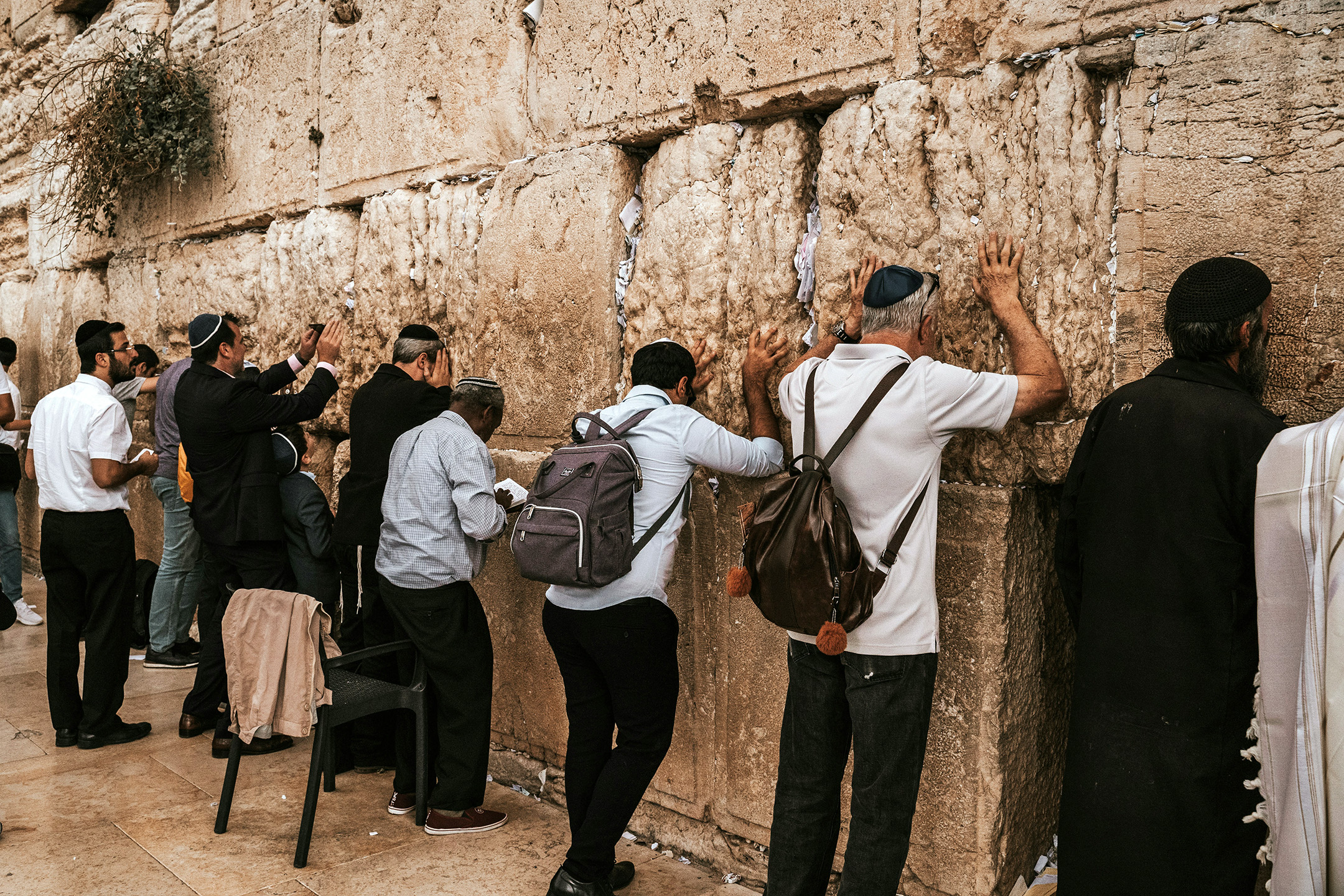



1. Historically, Judaism has been composed of the direct descendants of Abraham.
This reality is rooted in the covenant promises given to Abraham, particularly the promise that God would make of his many descendants a nation. Key biblical texts are:
- “I will make of you a great nation” (Genesis 12:2 ESV).
- “‘Look toward heaven, and number the stars, if you are able to number them.’ Then he said to him, ‘So shall your offspring be’” (Genesis 15:5; see, also 22:17, 26:4, 28:14).
- “You shall be the father of a multitude of nations. . . . I have made you the father of a multitude of nations. I will make you exceedingly fruitful, and I will make you into nations” (Genesis 17:4-6).
2. In addition to the direct descendants of Abraham, others, known as Gentiles, can embrace the Jewish faith through conversion.
The Gentiles include all peoples not of biological descent from Abraham, Isaac, and Jacob. By studying the religion and history of the Jewish people under the direction of a rabbi, by participating in prescribed rituals—including circumcision for males—and by affirming the Jewish way of life, one may embrace the Jewish faith and convert to Judaism.
3. A long history informs the current practice of Judaism.
Regardless of current perspectives, all Jews acknowledge a narrative of key historical markers. The historical timeline begins with Abraham, who lived over 3,500 years ago, and continues through his son, Isaac, his grandson, Jacob, and subsequent generations.
4. Key historical points defining the Jewish narrative include both biblical and more recent events.
- The covenant with Abraham, ca. 1800 B.C.
- The Exodus from Egypt and conquering of Canaan, ca. 1400 B.C.
- The kingdom established under Saul, David, and Solomon, followed by the divided kingdoms in the north (Israel) and in the south (Judah).
- The temple built in Jerusalem, ca. 950 B.C.
- Israel exiled to Assyria, 722 B.C.; Judah exiled to Babylon, 587 B.C.
- Return to Canaan and the rebuilding of the temple, beginning in 535 B.C.
- Destruction of Jerusalem and Herod’s temple by the Romans, AD 70.
- The Nazi Holocaust, during which six million Jews were killed, 1938-45.
- Founding of the modern state of Israel, 1948.
5. A significant body of thought, largely found in the Hebrew Old Testament and rabbinic commentaries, defines Judaism.
Written in Hebrew, with very brief texts in Aramaic, the Old Testament Scriptures—known to the Jewish people as the Hebrew Bible or the Tanakh, a Hebrew acronym for the divisions of its books: the Torah (Law), Nevi’im (Prophets), and Ketuvim (Writings)—tell the stories of creation, the fall of humankind, and the covenant people of Israel. The Hebrew Bible is especially concerned with this people, telling their story and declaring God’s faithfulness even in the face of Israel’s rebellious actions.
Also important are the Talmud and the Mishnah that are comprised, respectively, of commentaries and codified oral tradition.
6. Key emphases of Judaism include several theological concepts.
- The declaration of strict monotheism: “Hear, O Israel: The LORD our God, the LORD is one” (Deuteronomy 6:4).
- The centrality of the Law: “You shall diligently keep the commandments of the LORD your God, and his testimonies and his statutes, which he has commanded you” (Deuteronomy 6:17).
- God’s covenant relationship with Israel: “For you are a people holy to the LORD your God. The LORD your God has chosen you to be a people for his treasured possession, out of all the peoples who are on the face of the earth” (Deuteronomy 7:6).
7. Though there is significant agreement on the key emphases, great diversity exists within Judaism.
Distinctions in religious belief and practice are found among three major branches of Judaism today.
- Orthodox, or “traditional Judaism,” follows the Torah closely and regards its teachings as binding.
- Conservative Judaism emerged in the 19th century and, though keeping many traditions, does not adhere to the Law as consistently as Orthodox Judaism.
- Reformed Judaism also emerged in the 19th century and, even more than Conservative Judaism, leans toward modern sensibilities. Rather than devoutly following the prescriptions in the Torah, it emphasizes the moral and ethical nature of Judaism.
Among the Jewish people, there are also ethnic distinctions, largely resulting from geographic dispersion as portions of the Jewish population were exiled from the Land of Israel in antiquity. These diaspora communities developed into ethnic groups with distinct cultural and liturgical traditions. Although there is overlap today, the three largest include:
- Ashkenazi Jews: Descended from Jewish communities who settled in central and eastern Europe during the Middle Ages and traditionally spoke the Yiddish language.
- Sephardic Jews: Trace their heritage to the once-thriving Jewish community in Spain and Portugal which, after expulsion, dispersed to Europe, North Africa, the Middle East, and the Americas.
- Mizrachi Jews: Remained in the Middle East and North Africa, with some communities dating back to biblical times.
In addition to these groups, you will sometimes hear the term “Kabbalah,” which refers to a mystical type of Judaism in which followers search out hidden and enigmatic meanings within Jewish scriptures. Others describe themselves as “secular,” meaning they are ethnically Jewish but do not adhere to religious beliefs or practices.
8. Jews, especially those adhering more closely to the Torah, observe key holy days and festivals.
Among them are:
- The Sabbath: Remembers God’s rest on the seventh day during creation and is a day of rest and special devotion to God; observed from sundown on Friday to sundown on Saturday.
- Passover: Remembers and celebrates the deliverance of the Jews from Egypt; begins with the Passover seder meal and involves eating unleavened foods.
- Rosh Hashanah: The Jewish new year; begins the 10 high holy days or “days of awe.”
- Yom Kippur: The Day of Atonement; considered the holiest day of the year and observed with a 25-hour fast, prayer, and communal repentance.
- Sukkot: The Feast of Booths; remembers the 40 years of wandering after the Exodus and is celebrated by building and eating meals in a sukkah, or temporary structure.
- Hanukah: An eight-day festival commemorating the rededication of the temple under Judah Maccabeus (2nd century BC).
- Purim: A celebration in memory of the salvation of the Jews during the time of Queen Esther (5th century BC).
- Shavuot (Pentecost): Commemorates the giving of the law to Moses on Mt. Sinai; was traditionally also the firstfruits offering for the grain harvest.
9. When used to group together Christianity, Judaism, and Islam, the term “Abrahamic Faiths” is a misnomer.
The three traditions have in common that they originate geographically in the region where Abraham lived and that Abraham is named by their respective adherents as the Father or Patriarch of their faiths. However, Islam tells a very different story in that Abraham’s promised son (Genesis 15; also, see chapters 17 and 18) was not Isaac but Ishmael. This alteration in the story takes Islam in a very different direction, while Christians can speak legitimately of a common Judeo-Christian tradition in which New Testament Christianity fulfills the promises of the Old Testament.
10. How should I talk with my Jewish friend?
Many encourage, as the first step in sharing the gospel with Jewish people, that we establish friendships. However, one must not interpret this counsel to mean that our Jewish friends will simply “catch” the gospel by being around us. The gospel must be shared and explained, for, as Paul affirms, the gospel “is the power of God for salvation to everyone who believes, to the Jew first and also to the Greek” (Romans 1:16). Some of the objections to the gospel may include an insistence upon a strict monotheism vs. trinitarianism, especially in opposition to the divinity of Jesus; the argument that Christianity is a false sect denying the legitimacy of the Old Testament Law; and the existence of antisemitism displayed by Christians, along with the Holocaust.
Regarding the Trinity and Jesus’ divinity, we must acknowledge a certain mystery while demonstrating, from the Old Testament itself, the promises fulfilled in Jesus as Messiah. Regarding the Old Testament Law, we might use Jesus’ own summary of the Law in his response to the Pharisee’s question about the greatest commandment: “And [Jesus] said to him, ‘You shall love the Lord your God with all your heart and with all your soul and with all your mind. This is the great and first commandment. And a second is like it: You shall love your neighbor as yourself. On these two commandments depend all the Law and the Prophets’” (Matthew 22:37-40). With an explanation of these verses, we can affirm the Scriptures of the Jews while, at the same time, showing their fulfillment in Jesus, the Messiah.
The Holocaust and antisemitism sometimes seem to be almost intractable challenges. We must acknowledge the evil nature of both while declaring God’s love and provision for all peoples, Jews and Gentiles alike.
Our witness to our Jewish friends will be greatly challenging, but with much prayer, confidence in the Word of God, and reliance upon the Holy Spirit, we can give that witness with much hopefulness.