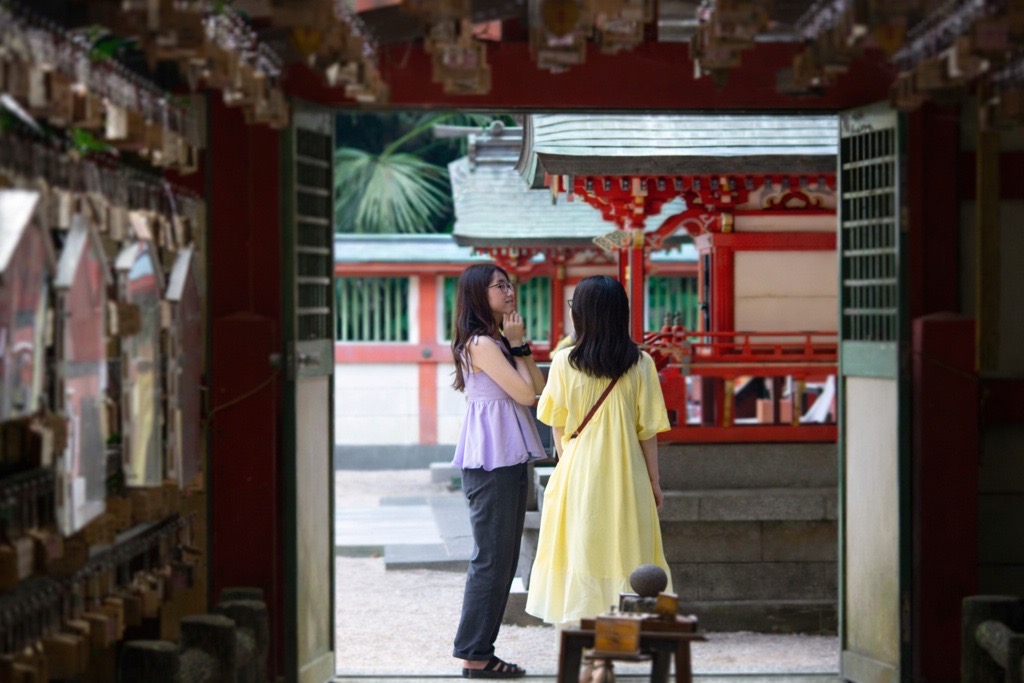



1. Shinto avoids the common definitions of a dogmatic tradition yet is still considered a religion.
Shinto, also known as Shintoism, loosely translates to “the way of the kami” and is the name of the national religion of Japan. Absent of a clear founder or creed, it has continued to exist less as a religion of “do’s and don’ts” and more as an understanding and practice based on the spiritual and natural realms. These beliefs and practices can coexist alongside a variety of other systems and practices. Today, many practitioners prefer not to classify Shinto as a religion in the traditional, dogmatic sense, but it certainly exhibits many features typical of religions worldwide.
2. Shinto has no founder, creed, or authoritative scripture.
Unlike Buddhism or Islam, Shinto does not have a historical founder of the belief system. Nor does it contain any documents that are binding to the practitioners. The Kojiki and the Nihon Shoki hold various myths, genealogies, and rituals, but they function more as historical chronicles of stories and practices. Belief statements do not hold premiere importance within Shinto; instead, it focuses more on collaborative participation in its practices.
3. Shinto beliefs and practices revolve around kami.
“Kami” can also be translated as “gods,” with the lowercase “g” being an important distinction. These gods are not like the popular gods of the Greek pantheon who had a clear realm of authority. Kami tend to be embodiments of natural features (e.g. rivers, trees, rocks), ancestral figures, or powerful forces such as natural disasters or fortune. They lack the omnipotence or perfection of a “God” in the capital “G” sense, as revered by monotheistic religions. Instead, kami can be helpfully understood as personifications of the impersonal, which are interacted with through the rituals of Shinto.
4. Shinto is about purity and pollution, not sin and forgiveness.
Whereas other religions focus on the understandings of moral debt and forgiveness or the need of a savior, Shinto focuses on things being pure or being polluted. As represented in the story of Izanami and Izanagi, the Shinto creation myth, the rites of purification mirror the cleansing that Izanagi performed to restore himself after his trip to the underworld (a place known as Yomi). According to the story, Izanagi’s cleansing in the ocean created many of the other primary kami who now receive veneration. This has led to an emphasis on water purification and cleansing rites in Shinto.
5. Practice is prioritized rather than beliefs.
Whether it is at the major temples and shrines or at a shrine within the home, Shinto is demonstrated through its practices instead of a person’s words. Communication with the kami is an embodied ritual for Shinto practitioners, expressed through the washing of hands, ritual clapping, offering of coins, or prayer. Shinto straddles the line of cultural practice and religious system. While average Japanese persons would participate in the various rituals and festivals of Shinto, they could at the same time claim to be non-religious. The cultural emphasis on conformity lends itself to a situation in which adherents follow the practices of Shinto without necessarily holding the corresponding beliefs that support the actions.
6. Shinto lends itself to syncretism.
Thanks in part to the presence of Buddhism in Japan, Shinto has long coexisted with other belief systems. Also, because of its lack of exclusive claims, Shinto can allow other religions to be picked up and interwoven into the lives of its practitioners. It is relatively common for Japanese persons to be blessed as children in a Shinto shrine and have their funerals at a Buddhist temple.
7. Shinto is considered Japanese, while Christianity is seen as Western.
Although Christians would quickly recognize that Christianity is not merely a Western religion, for the Shinto Japanese person, this depiction is readily assumed. In the minds of many Japanese people, the Christian identity is closely tied to the West, and to the United States in particular. We must recognize that Shinto practitioners have prior assumptions which need to be sorted through before the gospel could even be presented in a way that he or she could understand. Contrary to what may be first perceived by the Shinto practitioner, Jesus does not require the person to stop being Japanese in order to trust in him.
8. Japanese culture and Shinto are nearly inseparable from each other.
Many Shinto rituals are practiced by Japanese people even if they would not necessarily claim Shinto for themselves. Visits to shrines, festivals, blessings for children, and various ceremonies all act as cultural practices as much as religious practices. This mixing makes drawing a line between culture and religion extremely difficult.
9. Shinto allows for Jesus, even if Jesus does not allow for Shinto.
Due to the syncretistic nature of Shinto practitioners, it can be very easy to present Jesus in a way that appeals to them. That appeal could lead someone to attempt to adopt Christ into his or her existing personal system of Shinto. The syncretism of the Japanese people has been illustrated as multiple bowls of food on a tray. A person can eat what he or she wants from each bowl. We must be careful that Jesus becomes the only bowl.
10. Shinto emphasizes community, but Christians can offer community and truth.
We, as Christians, are called to make a defense for the hope that is within us. The danger exists that we will make that defense with a critical spirit that focuses exclusively on arguments rather than on people. In Shinto, an emphasis is placed on communal practices above belief statements. Those who are seeking to share the gospel with Shinto practitioners must aim to live out the Christian faith publicly and in community. When the truth of Jesus Christ is proclaimed through the sweet warmth of Christian community, the Shinto practitioner is offered more than just another religion to follow blindly. The Shinto practitioner is offered a sufficient and better replacement to what he or she already has.
For our Shinto friends and neighbors, a system of beliefs without a community would not be sufficiently appealing. Similarly, a collection of practices without true motivating beliefs will be little better than what they already have. When we engage Shinto practitioners with the gospel, we must therefore offer both a loving community and beliefs rooted in truth. Let us endeavor to proclaim and defend that truth with gentleness and respect, while also demonstrating a loving community that welcomes those from every nation.
See how God is using ABWE missionaries and local churches to confront cultural strongholds and establish Christ’s church in Japan.