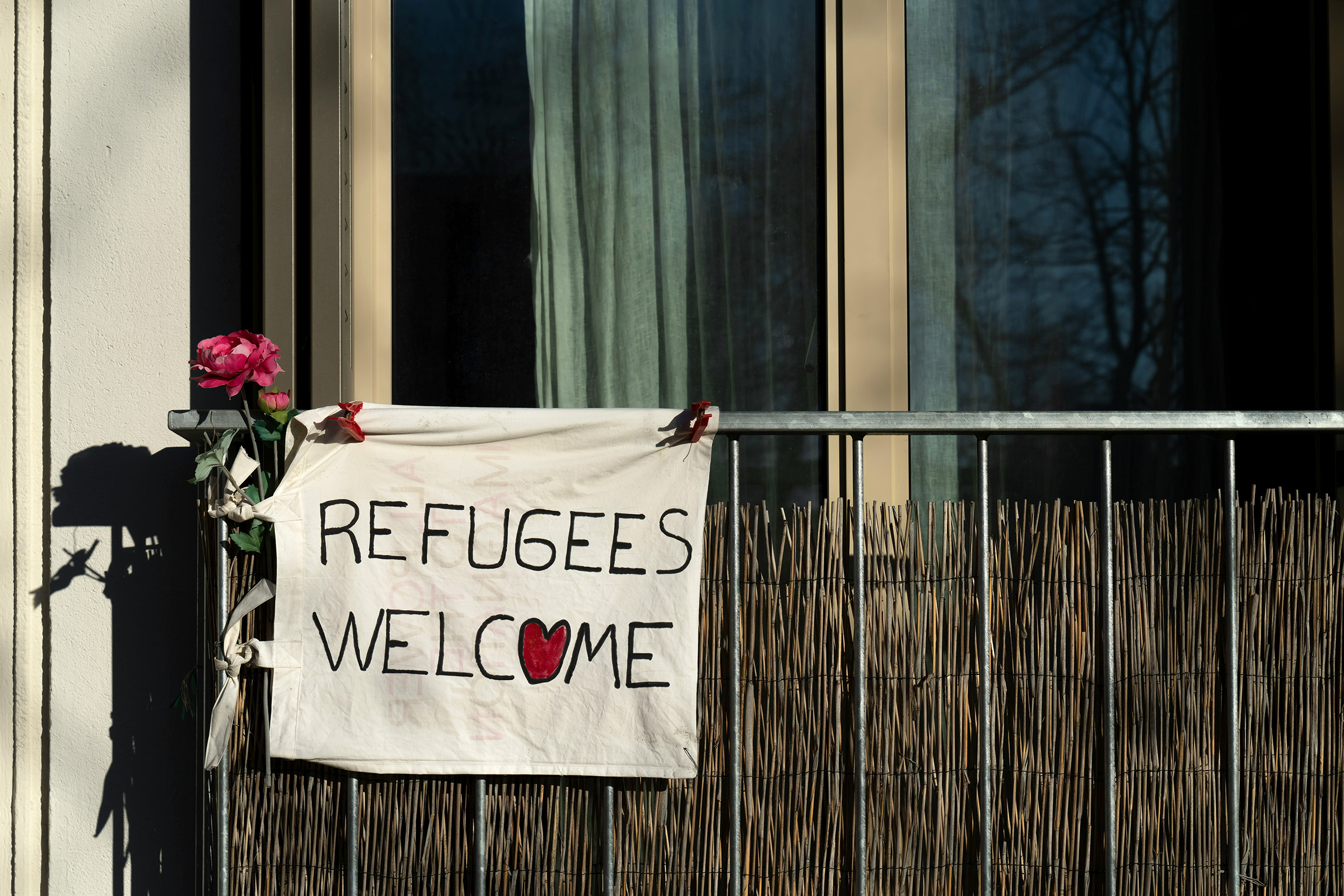



On May 12, 2025, 59 white South African Afrikaners arrived in the US under a refugee program initiated by President Donald Trump.
These Afrikaners, representing descendants of Dutch and French settlers who once led South Africa’s apartheid government, sought asylum due to rising threats of racial violence and property loss faced by Boers in post-apartheid South Africa.
They aren’t the only ones facing difficulties; more than 67,000 Afrikaners have expressed interest in resettlement due to land expropriation policies and marginalization. Yet, what would have seemed to many to be a relatively innocuous refugee arrival—after all, the US processes hundreds of thousands of asylum applications each year—sparked outraged reactions across the media and online. “SEND THEM TO AUSTRALIA,” posted one X.com user. “[T]hey couldn’t even make it in South Africa where they have ALL the privilege,” bemoaned another. To blame for these incendiary responses is the simple fact that these Afrikaners were not members of a group traditionally considered oppressed or holding minority status, but white members of the historical Dutch-descended population.
A Christian Perspective on Compassion
While Christians, whose highest loyalty is to Christ and his spiritual people composed of every ethnicity (Colossians 3:11), never approach such hot-button cultural and political issues as mere partisans, this situation represents an opportunity for believers in Christ to examine their own cultural assumptions—including their prejudices and dispositions about what it looks like to love the foreigner and the stranger.
Many Christians have settled for a sentimentalized view of compassion ministry and international missions. For one reason or another, American evangelicals in particular tend to conceive of missionary activity in picturesque, stereotypical forms impressed upon the imagination—an attractive, young, probably Caucasian college-aged girl and a team of fellow students taking the obligatory selfie with dark-skinned orphans on their hips. Just ask an AI image generator to produce a generic, stereotypical image of a missionary, and you can expect just such a result. Of course, that is not to imply that this is not a valid form of ministry activity; there are many good reasons a group of young people might find themselves in a place like Haiti or perhaps in an African nation working with orphans, even for a very short period of time. But behind these stereotypical images lies a complex web of assumptions about what constitutes true missionary work. Catechized by modern multiculturalism, we often equate “making disciples of all nations” with centering our efforts only on those who look very different from us or who are very far away geographically. We interpret “love your neighbor” with affluent Westerners helping those who are literally destitute in the developing world, sometimes even to the exclusion of other peoples—including brothers and sisters in Christ—whom we fly over on our way to these far-flung places. We have settled for a certain missionary mystique which then informs our assumptions about biblical compassion.
The complex plight faced by South Africa and its several peoples reminds American evangelicals that the call of God to show compassion and extend the love of Christ among the nations is not limited to these simplistic images we hold in our minds. One South African missionary, whose ministry reaches mostly whites, shared that he has “at times almost felt a need to prove the depravity of some whom we minister because of their skin colour or economic status.” We are called to have equal weights and measures—to judge by the consistent standard of God’s Word and not expediency (Proverbs 20:10). If seeing a ministry or even a government extend one type of compassion to one group of people causes us to cheer while the same act towards a different group of people causes us to recoil, we are likely engaged in partiality, which Scripture explicitly forbids (James 2:1-9).
Thinking in Biblical Categories
The Great Commission and the second-greatest commandment both compel us to reach not only those who are obviously different from us—those whom perhaps we feel extra virtuous by serving—but also those who happen to look like us, those to whom service will earn no extra social or cultural points. We must also recall that those who are lost in the true biblical sense are not merely lost because they are utterly impoverished or lack access to the sorts of amenities Americans tend to take for granted; rather, to be lost is to be without Christ—to be dead in our sins and trespasses apart from the grace of God in the gospel (Ephesians 2:1-2), and this is a state into which all mankind, black and white, rich and poor, are naturally born. The human race cannot be divided into simplistic, ideological categories like oppressor versus oppressed, or colonizer versus exploited people, but rather, the problem of sin and the need for a Savior and true Christian love cut across racial, socioeconomic, and political lines. Hence, Christians cannot afford to make decisions about who should receive our gospel witness and compassion based simply on appearances or assumptions.
The situation facing Afrikaners is a reminder that the world’s physical and spiritual needs are deeper than what we are accustomed to seeing in the latest Facebook feed photo dump from our church’s youth group’s summer service trip to some far-flung place. Every people group—those near and far, like us and not like us—is owed the gospel and needs compassion from those capable of showing it. Our English-speaking neighbors down the street need the light of Christ just as much as those in remote villages filled with unreached people groups, just as much as the secularized masses in once-Christianized Europe, and just as much as the persecuted believers and unreached millions in atheistic China. As one ABWE missionary in South Africa has reflected, the up and out need the gospel as much as the down and out. May we judge with righteous judgment and love our neighbors—those unlike us and even those like us—as ourselves.